
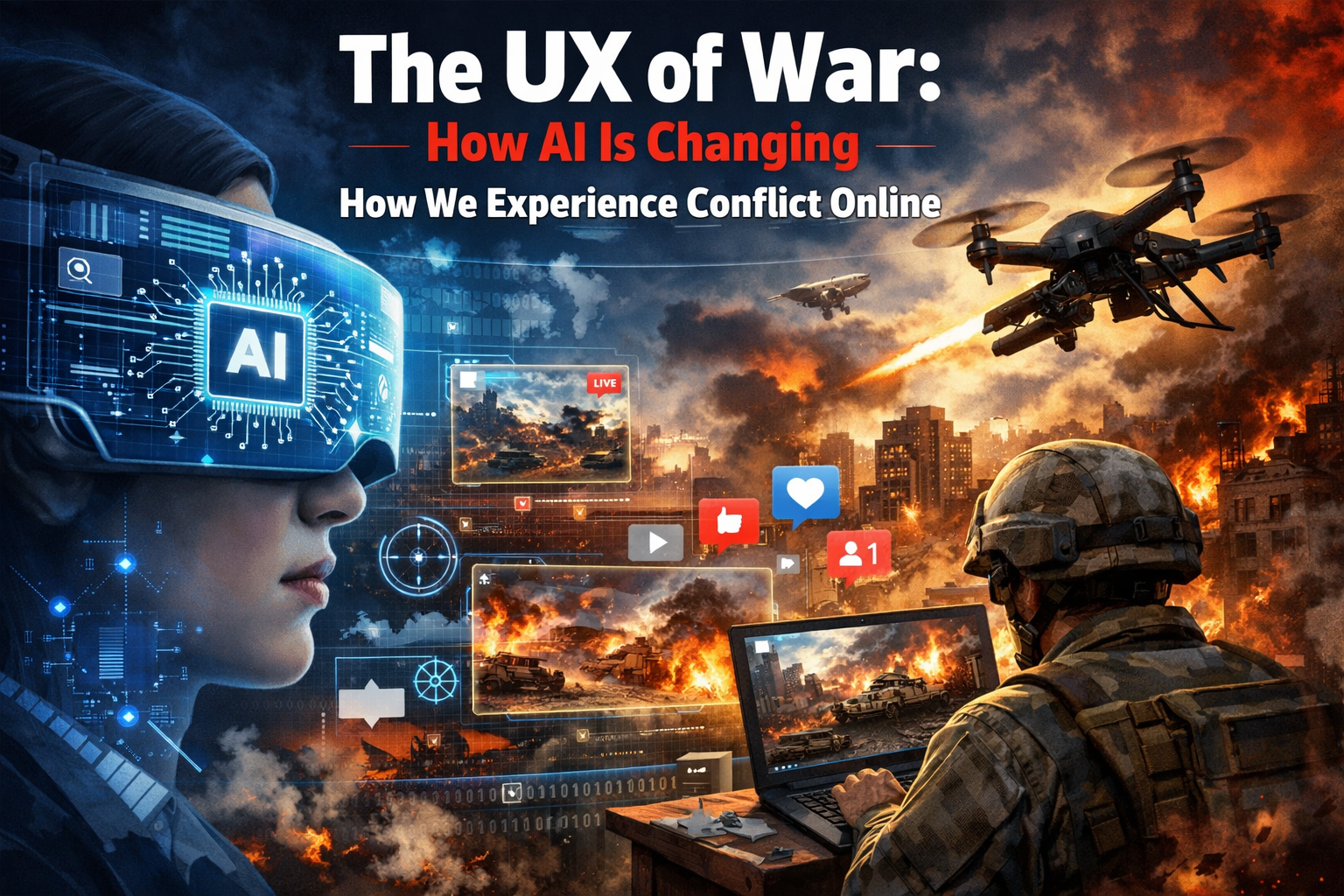
War has always been shaped not just by weapons, but by perception. From radio broadcasts in World War II to live TV coverage during the Gulf War, each technological leap has altered how civilians experience conflict. Today, artificial intelligence is redefining this experience yet again—turning war into something we don’t just witness, but scroll through, react to, and unknowingly participate in.
Welcome to the new user experience (UX) of war—where the battlefield extends into feeds, algorithms shape narratives, and reality itself is increasingly negotiable.
1. War as a Feed: The Scrollable Battlefield
For most people today, war is no longer experienced through newspapers or even traditional news broadcasts. It appears as a stream of content—tweets, reels, memes, drone footage—intermixed with entertainment and everyday life.
Social media has effectively turned conflict into a continuous, personalized feed. The invasion of Ukraine, for instance, has been described as one of the first wars experienced largely through passive scrolling and user-generated content. ()
AI intensifies this shift by:
- Curating what you see through recommendation algorithms
- Amplifying emotionally engaging content (often outrage or fear)
- Personalizing war narratives based on your behavior
The result? No two people experience the same war.
2. The Rise of Synthetic Reality
Artificial intelligence has introduced a new layer to the fog of war: synthetic media.
Deepfakes, AI-generated images, and fabricated audio clips can now mimic reality with alarming accuracy. A notable example was a fake video of a political leader surrendering during a conflict—quickly debunked, but widely circulated before the truth caught up. ()
AI-generated content is used to:
- Create fake battlefield victories
- Simulate attacks or casualties
- Impersonate leaders or soldiers
- Flood platforms with convincing propaganda
In modern conflicts, misinformation is no longer accidental—it is strategically engineered at scale. ()
3. Information Warfare as UX Design
War today isn’t just fought with missiles—it’s fought with interfaces and narratives.
AI enables actors to:
- Analyze public sentiment in real time
- Tailor messaging to specific audiences
- Deploy bots and automated accounts to amplify narratives
This transforms propaganda into something closer to product design—optimized for engagement, retention, and emotional impact.
In recent conflicts, coordinated campaigns have used AI-generated memes, fake videos, and targeted messaging to influence public opinion globally, making information warfare a central pillar of military strategy. ()
The UX of war is no longer about informing—it’s about persuading, polarizing, and performing.
4. Gamification and the “Video Game War” Effect
One of the most disturbing shifts is the gamification of conflict.
AI-enhanced visuals, drone camera feeds, and meme culture have made war look and feel like a video game. Some conflicts are now presented online through simplified, gamified narratives—reducing complex geopolitical crises into “wins,” “losses,” and viral moments. ()
This creates:
- Emotional detachment from real human suffering
- Shortened attention spans toward serious events
- A tendency to treat war as content rather than catastrophe
When war becomes entertainment, empathy becomes optional.
5. The Collapse (and Reconstruction) of Truth
The internet fragmented our shared sense of reality. AI is now both accelerating and potentially repairing that fracture.
On one hand:
- AI can mass-produce misinformation faster than humans can verify it
- Echo chambers are reinforced by algorithmic feeds
- Trust in institutions continues to erode
On the other hand:
- AI tools can assist in fact-checking and detecting fake content
- Large language models can guide users toward more reliable information
Some experts argue AI could even help rebuild a shared understanding of truth—though this outcome depends heavily on governance and design choices. ()
6. The Psychological War You’re Already In
Modern warfare operates on three levels:
- Physical (weapons and combat)
- Informational (media and narratives)
- Psychological (perception, fear, belief)
AI supercharges the third.
By controlling what people see—and how often they see it—AI systems influence:
- Public morale
- Political polarization
- International support for conflicts
As one observer noted in online discussions, modern war now includes simultaneous “kinetic, information, and psychological” battles—all intertwined and amplified by digital platforms. ()
The user is no longer just a spectator. They are part of the system.
7. From Battlefield to Interface: A New Responsibility
The UX of war raises urgent ethical questions:
- Who is responsible for AI-generated misinformation?
- Should platforms regulate war-related content differently?
- Can users realistically distinguish truth from fabrication?
Design decisions—what gets boosted, flagged, or removed—now carry geopolitical consequences.
War is no longer confined to geography. It exists in interfaces, shaped by algorithms, experienced through screens, and influenced by every click, like, and share.
Conclusion: War, Reimagined
Artificial intelligence has not just changed how wars are fought—it has changed how they are felt, understood, and remembered.
The modern user doesn’t just witness war. They:
- Scroll through it
- React to it
- Share it
- And sometimes, unknowingly, help shape it
The UX of war is immersive, personalized, and deeply unstable.
And as AI continues to evolve, one question becomes unavoidable:
If war is now a user experience—who is designing it?