
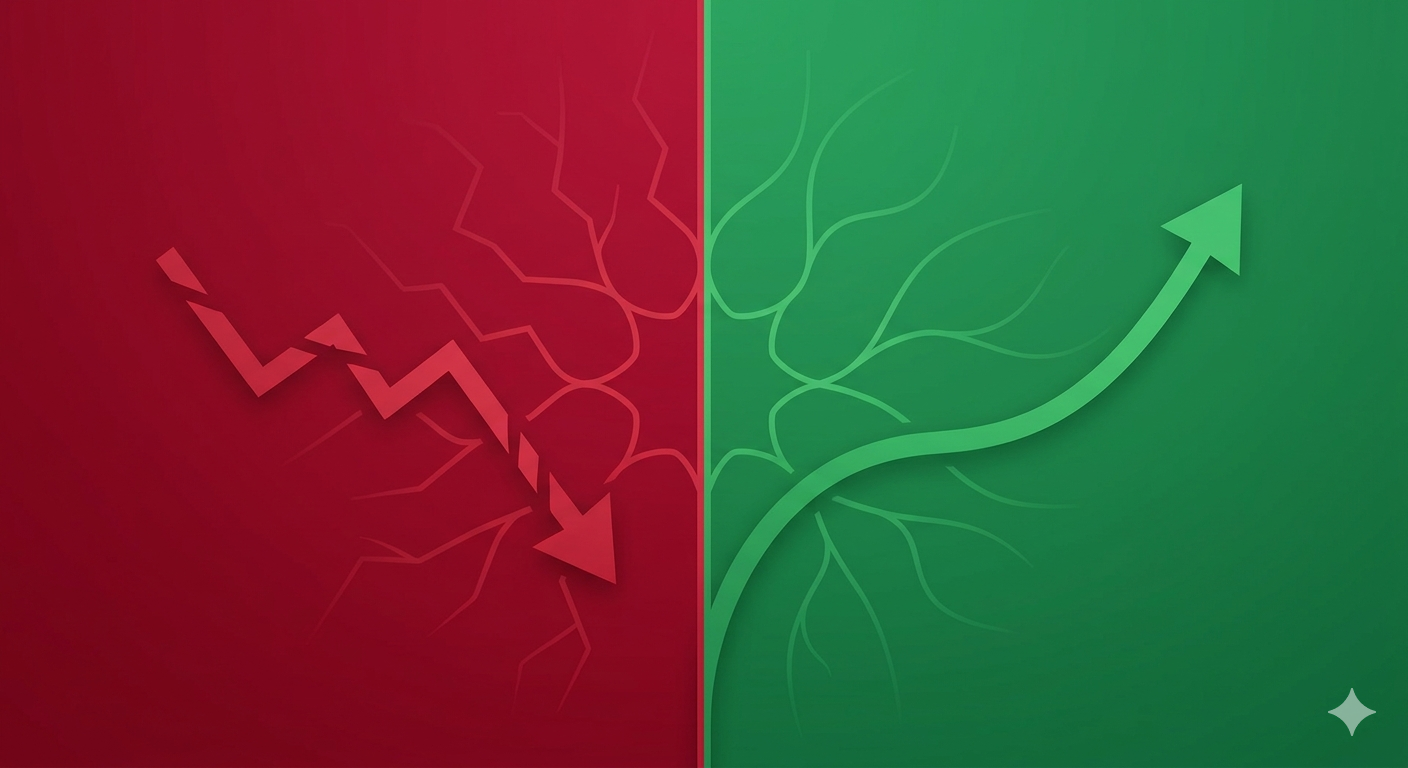
We like to think of the stock market as a realm of pure logic—a digital landscape governed by $P/E$ ratios, moving averages, and cold, hard data. But the moment you open your brokerage app, you aren’t just looking at numbers. You’re being hit with a psychological “color splash” designed to trigger ancient biological responses.
In the world of trading, Red and Green aren’t just labels; they are emotional conductors.
The Red Alert: The Biology of Panic Selling
In nature, red is the color of blood, fire, and toxic berries. It’s an evolutionary “stop” sign. When your portfolio turns bright red, your brain doesn’t just see a 5% dip; it sees a threat.
-
- The Amygdala Hijack: Seeing red can trigger the amygdala, the part of the brain responsible for the fight-or-flight response. This increases cortisol levels, leading to “tunnel vision.”
- Loss Aversion: Psychologically, the pain of losing is twice as powerful as the joy of gaining. Red intensifies this bias, making the urge to “get out now” feel like a survival necessity rather than a financial decision.
The Green Light: The Dopamine of Greed
Conversely, green is the color of lush environments, growth, and safety. In a trading interface, a sea of green acts as a powerful reward signal.
-
- Dopamine Spikes: Watching a green candle climb releases dopamine—the same chemical released by gambling or sugar. This creates a “positive feedback loop” where you want to keep buying to sustain the high.
- FOMO (Fear Of Missing Out): Green creates a sense of momentum. It whispers that the party is happening now, and if you don’t jump in, you’ll be left behind in the “barren” red.
The “Default” Bias: Why It’s Hard to Ignore
Interestingly, this color coding isn’t universal. In some Eastern markets (like China), red symbolizes luck and prosperity, so it often represents a gain, while green or blue represents a loss.
However, for most Western traders, the color palette is fixed. This creates a cognitive shortcut:
-
- Stimulus: Red ticker symbol.
- Emotion: Anxiety/Fear.
- Action: Panic Sell.
By the time your rational mind calculates that the company’s fundamentals are actually fine, your finger has already hovered over the “Sell” button.
How to De-Bias Your Trading
If you want to trade like a pro, you have to learn to “mute” the colors. Here are three ways to reclaim your logic:
-
- Go Greyscale: Many professional trading platforms allow you to change your chart colors to black and white or hollow candles. This strips away the emotional “heat” of the movement.
- The 10-Minute Rule: If a sea of red makes your heart race, close the app for ten minutes. Let the cortisol levels drop before making a move.
- Focus on Percentages: Train your eyes to look at the numerical value ($X\%$) rather than the color of the background. A 1% dip is a 1% dip, whether it’s colored red or neutral grey.
The bottom line: The market is designed to be addictive and reactive. By understanding that your “panic” or “greed” is often just a biological reaction to a color palette, you gain the ultimate trading edge: objectivity.