
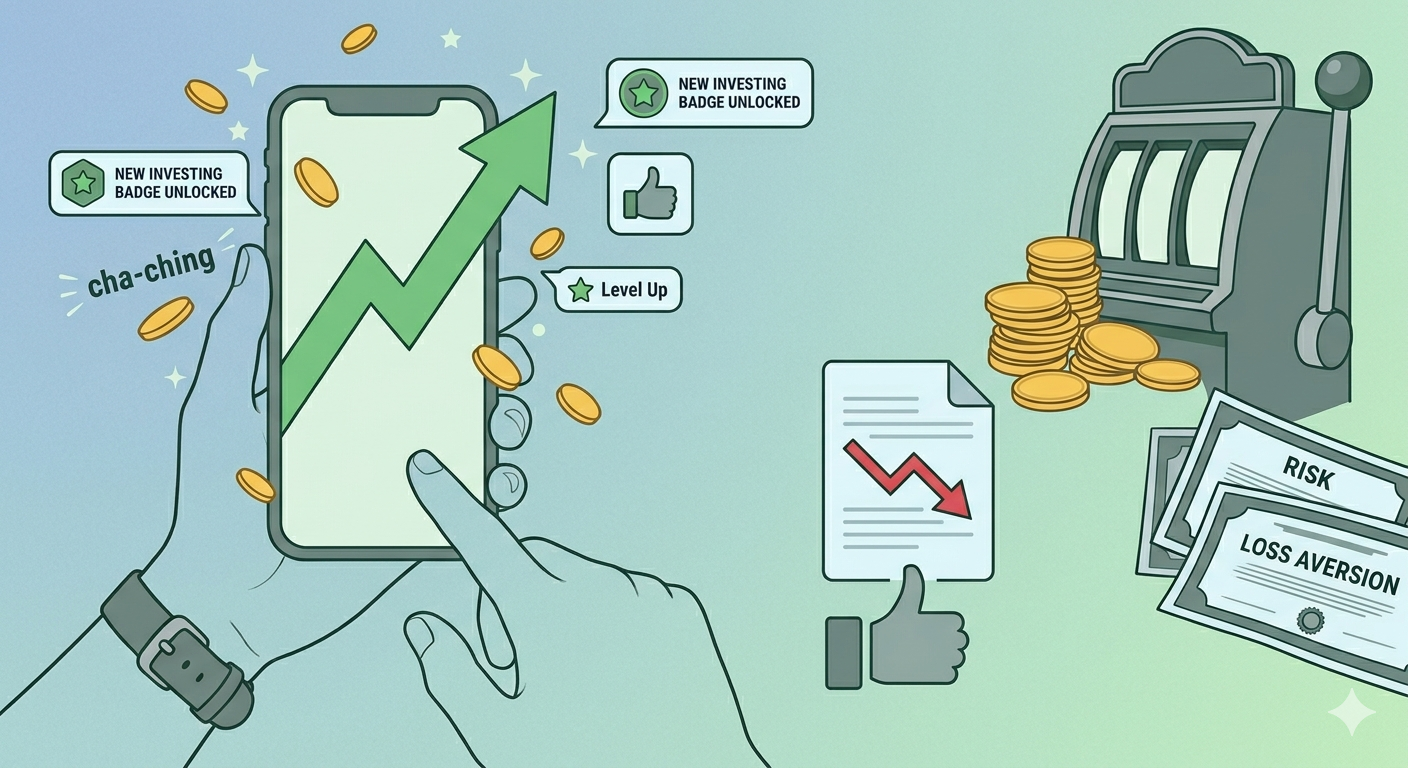
Imagine you’re scrolling through your favorite investment app. You buy a few shares of that promising tech stock, and suddenly, colorful confetti bursts across your screen, a satisfying “cha-ching” sound plays, and a bright notification pops up: “Level Up! New Investing Badge Unlocked!”
It feels exciting. It feels rewarding. And it’s designed exactly that way.
This isn’t just a fun feature; it’s a sophisticated psychological technique known as gamification. By incorporating game-like elements into investing interfaces, financial technology companies (Fintechs) are dramatically changing how retail investors – everyday people like you and me – approach the stock market. This phenomenon is often dubbed the “Slot Machine” Effect, and its impact is profound, complex, and potentially risky.
Why Gamification Works: The Science of “Ding!”
Gamification isn’t magic; it’s behavioral science in action. It leverages fundamental human psychological needs and triggers to drive engagement:
- Instant Gratification: We crave immediate rewards. In traditional investing, rewards can take months or years. Gamification provides instant feedback loops. A purchase is confirmed with a visual celebration. A portfolio increase is highlighted with vibrant green and exciting metrics. These mini-wins release dopamine, the “feel-good” neurotransmitter, creating a pleasurable association with the app and encouraging repeated action.
- Progress and Achievement: We are motivated by a sense of advancement. Gamified apps track progress with levels, points, and badges. Achieving these artificial milestones triggers a sense of accomplishment, even if the progress is purely cosmetic and doesn’t reflect actual financial gains. It turns the long-term journey of investing into a series of satisfying short-term goals.
- Competition and Social Proof: We are inherently social and competitive. Leaderboards, social sharing features, and notifications about “what others are trading” tap into our desire to compare ourselves to others and fit in. Seeing others succeed (or apparently succeed) can create FOMO (Fear of Missing Out), prompting us to take action.
- Loss Aversion: We are more motivated to avoid losing something than we are to gain something equivalent. Gamification can cleverly frame actions as preventing a loss (e.g., “Don’t let your streaks break! Login and make a trade today!”). This subtly encourages more frequent, and potentially unnecessary, activity.
The “Slot Machine” Effect in Action: Specific Gamification Techniques
Fintechs employ a wide array of gamified UI (User Interface) design choices, many of which are reminiscent of features found in casinos:
- Vibrant Visuals and Sounds: Confetti animations, fireworks, energetic music, and celebratory sounds create an atmosphere of excitement and reward for simple actions. This directly mimics the feedback loop of winning small amounts on a slot machine.
- Push Notifications and Alerts: Constant notifications about market movements, “trending” stocks, breaking news, or even just friendly reminders to check the app create a sense of urgency and keep users continuously engaged, much like the lights and sounds from across a casino floor.
- Levels, Badges, and Points: Arbitrary status symbols (e.g., “Silver Investor,” “HODL Master Badge”) reward users for actions like logging in daily, making their first trade, or diversifying their portfolio. While potentially educational, these are primarily engagement drivers.
- Leaderboards and Social Feeds: Displaying performance metrics of other users, even if anonymous, fosters competition and a desire to climb the ranks, often encouraging more active (and riskier) trading rather than long-term investing.
- Simulated “Scratch-Offs” and Free Stocks: Rewards like “spin the wheel” for a free fractional share or mystery rewards for inviting friends create an element of chance and excitement, directly linking the platform to the thrill of gambling.
- Simplified Interfaces: Making trading “frictionless” – a single swipe or click to buy/sell – removes the natural barriers and moments of reflection that are crucial for sound financial decision-making. The app feels like a game, not a complex financial tool.
The Consequences: The Good, The Bad, and The D-Word
The impact of gamified investing is a double-edged sword:
The Potential Good:
- Increased Engagement: Gamification can make investing feel less intimidating and more approachable, especially for beginners and younger demographics. It can democratize access to financial markets and encourage people to start planning for their future.
- Educational Value: Some gamification elements can be designed to teach financial concepts (e.g., diversifying for a badge). When implemented correctly, it can make learning about finance more engaging.
- habit Formation: It can help foster positive habits like regular contributions or consistent portfolio monitoring, which are crucial for long-term financial health.
The Potential Bad (and Risky):
- Increased Trading Frequency: The constant feedback and rewards encourage more frequent buying and selling. For the average retail investor, increased trading almost always leads to higher transaction costs (even with “commission-free” models, there’s always a bid-ask spread) and lower overall returns compared to a buy-and-hold strategy.
- Greater Risk-Taking: Gamification can blur the lines between long-term investment and short-term speculation. The excitement can normalize higher-risk behaviors, such as options trading or investing in volatile “meme stocks,” without a proper understanding of the associated dangers.
- Overconfidence Bias: Achieving artificial milestones (like badges) can give investors an inflated sense of their own competence, leading them to believe they “know the game” and are more skilled than they actually are, potentially leading to significant financial losses.
- Addictive Behavior: The core mechanisms of gamification are designed to create habitual and potentially addictive use. For some vulnerable individuals, the dopamine loop of investing apps can mirror the compulsive cycle of gambling.
- Distortion of Financial Goals: The focus shifts from sound, long-term financial planning (like retirement saving or a house down payment) to short-term excitement and achieving artificial in-app goals. Investors might make decisions based on what gets them more “points” or “badges” rather than what’s best for their financial future.
The Ethical Question: Are Fintechs Responsible?
This rise in gamification raises critical ethical questions. Are Fintech companies empowering investors, or are they exploiting behavioral biases to maximize their own user engagement and profits (often generated through Payment for Order Flow, which relies on high trading volume)?
Regulators like the SEC (Securities and Exchange Commission) and FINRA (Financial Industry Regulatory Authority) are increasingly paying attention. They are concerned about whether these gamified interfaces create undue pressure to trade, mask significant risks, and potentially violate regulations intended to protect investors from predatory practices. The line between user engagement and manipulation is becoming increasingly thin.
Empowering Yourself: How to Spot and Resist the “Slot Machine” Effect
As a retail investor, awareness is your greatest asset. While you can’t control how an app is designed, you can control how you interact with it. Here’s how to navigate a gamified investing landscape responsibly:
- Recognize the Tactic: Simply knowing about the “Slot Machine” Effect can diminish its power. Understand that the confetti and “dings” are there to manipulate your behavior, not to make you a better investor.
- Focus on Your Long-Term Plan: Before you make any trade, ask yourself: “How does this fit into my long-term financial goals (e.g., retirement, buying a home)?” If the answer is “It doesn’t, but it seems exciting,” that’s a red flag.
- Turn Off Non-Essential Notifications: Silence the constant buzz of market alerts and “trending” updates. Manually check your portfolio on a schedule (e.g., once a week or once a month) instead of letting the app dictate when you engage.
- Implement Friction: Introduce your own barriers to impulse trading. Before executing a trade, force yourself to write down the reason for the decision, the potential risks, and your planned exit strategy. Wait at least 24 hours for non-urgent trades.
- Beware of “Zero Commission” Hype: Understand that “commission-free” doesn’t mean “cost-free.” Remember that every trade still incurs costs. Don’t let the lack of a explicit fee encourage you to over-trade.
- Educate Yourself Outside the App: Don’t rely solely on the gamified lessons within the platform. Utilize independent, reputable financial education resources from trusted, non-commercial sources to build a solid foundation.
- Use Gamification Mindfully: If you enjoy the gamified aspects, use them intentionally for positive reinforcement of good habits (e.g., earning a badge for setting up an automatic monthly contribution). Ignore the competitive and trade-inducing elements.
The Future of Retail Investing
The integration of gamification into finance is not a passing trend. It’s an evolution in how we interact with our money, driven by technology and psychology. Fintechs will continue to refine their techniques, making apps more engaging and potentially more manipulative.
The challenge for the future is to harness the power of gamification for positive financial education and responsible long-term investing while strictly regulating its potential for harm. As an individual investor, your responsibility is to be a critical user. By understanding the psychology at play, you can enjoy the convenience of modern investing tools without falling into the “slot machine” trap and jeopardizing your financial well-being. Investing should be a powerful tool for building wealth, not a game of chance.